10 Benefits of a Business Website in 2026
The benefits of a business website in 2026 include more credibility, search visibility, customer insights, stronger marketing, and more control.
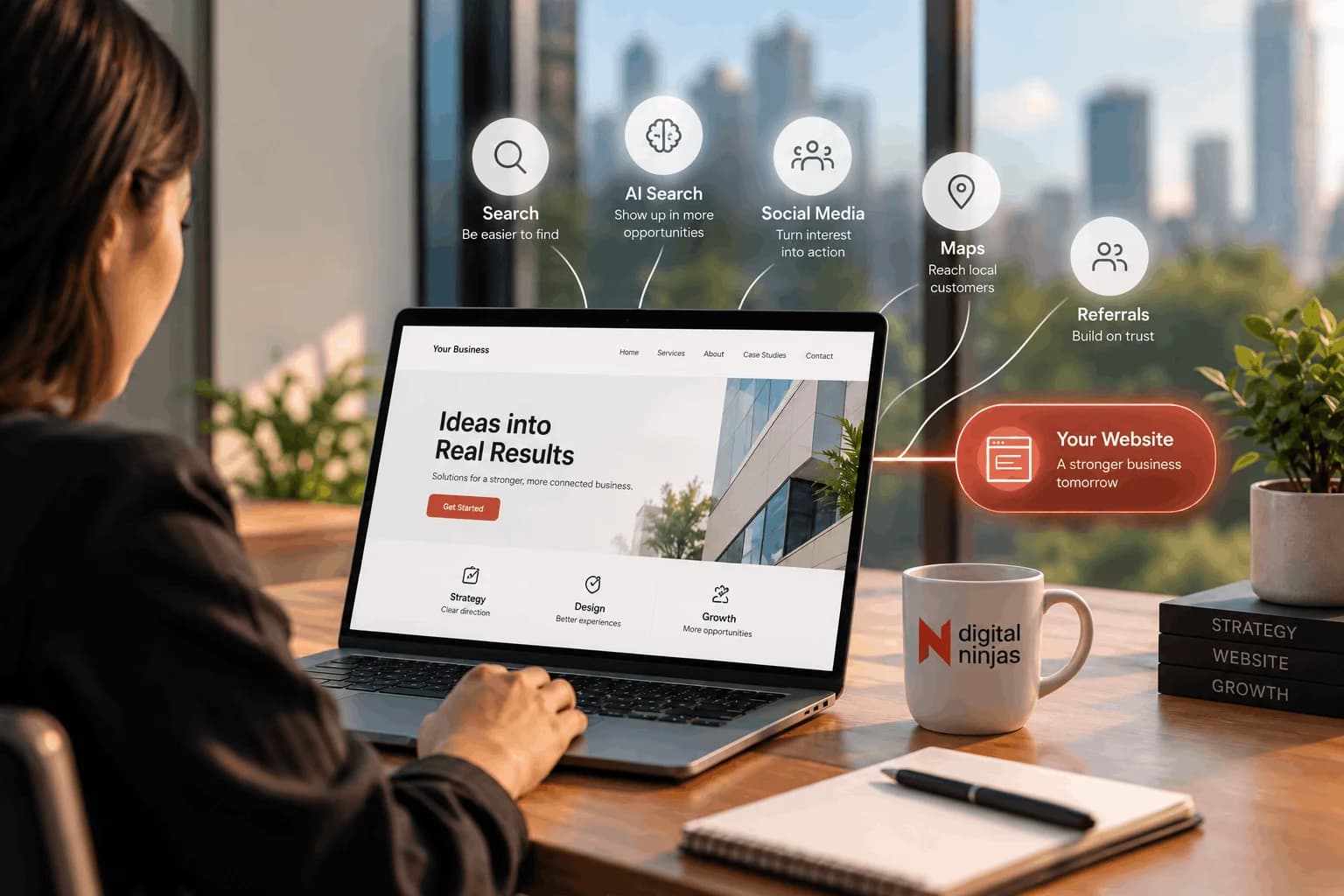
The benefits of a business website go far beyond looking professional. A good website gives customers a place to verify your business, understand what you offer, find you through search, and take the next step. It also gives you more control over your content, customer journey, and long-term digital presence.
A website is not magic, though.
The real business website benefits come from how well the site supports discovery, credibility, and action.
Putting five pages online will not automatically bring leads through the door. What matters is whether those pages make your business easier to find, understand, trust, and contact.
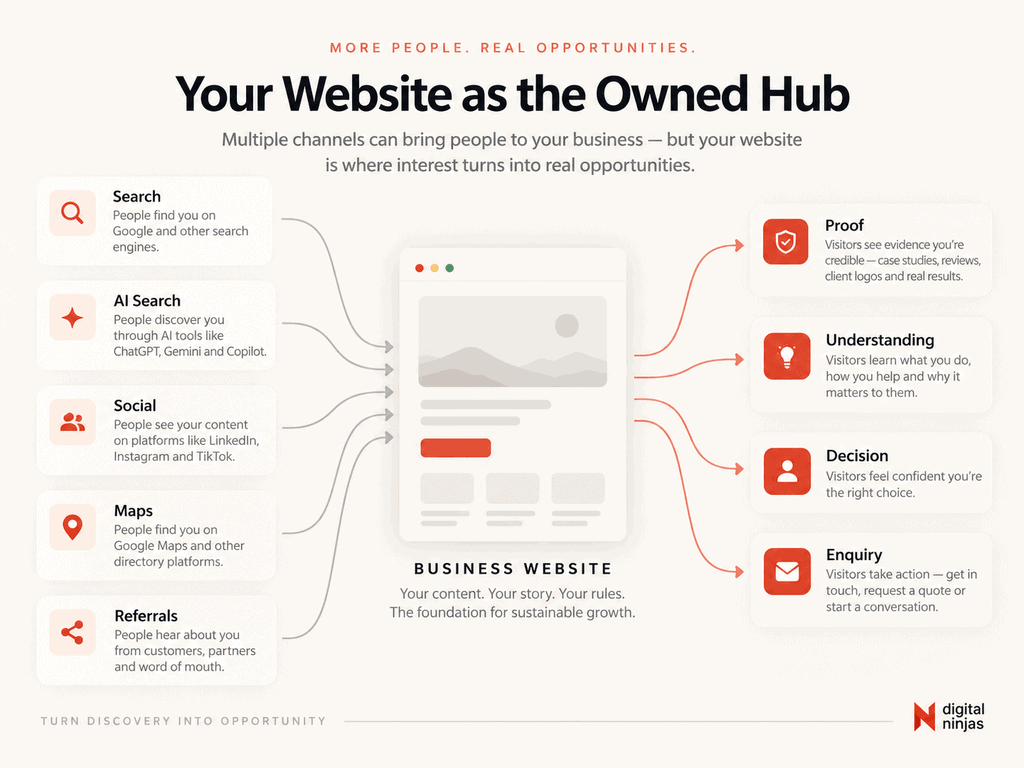
That distinction matters even more in 2026 because people are no longer discovering businesses through one channel. Search, social media, maps, referrals, review platforms, and AI-powered search can all play a part.
Your website is where those paths can come together.
We see this fairly often: a business can look active online and still make potential customers work too hard to understand what it actually offers.
So what does a business website actually do for you?
Quick View
What Are the Benefits of a Business Website?
The main benefits come down to visibility, trust, control, and making it easier for potential customers to understand and contact your business. The ten points below show how those benefits play out in practice.
1. It gives customers a place to verify your business
Before someone contacts you, there is a good chance they will check you out first.
They may have discovered you through a referral, an Instagram post, a Google search, an ad, or even a conversation with someone else. But discovery and trust are two different things.
Your website gives them somewhere to confirm the details.
Who are you? What do you do? Who do you work with? Where are you based? Can they see examples of your work? Is there a clear way to contact you?
For a service business, those answers may live across your homepage, service pages, About page, case studies, testimonials, and contact page. For a retailer, they may include product information, delivery details, returns, and support.
The point is not simply to “look professional.”
It is to remove doubt.
A polished logo and a good social presence help. But credibility becomes much stronger when customers can find actual evidence behind the business.
2. You have more control over the platform
Your social profiles are useful, but you operate within somebody else’s platform.
The layout is theirs. The algorithm is theirs. The rules are theirs. Features and reach can change. Accounts can be restricted.
A website gives you considerably more control over how your business is presented.
You decide which services deserve their own pages. You decide what visitors see first. You choose how much detail to provide, where calls to action appear, and how someone moves from learning about you to contacting you.
That does not mean a website is completely independent. You still rely on a domain registrar, hosting provider, software, and other services.
But compared with a social profile or marketplace listing, it is the digital channel where your business has far more control over the experience.
That level of control is one of the strongest reasons to have a business website rather than relying entirely on third-party platforms. That makes it a much stronger long-term foundation.
3. It helps more people discover your business
Your website can create opportunities to be found by people who have never heard of your business.
That is one of the biggest benefits of having a website for your business.
Search engines can index individual pages about your services, locations, products, questions, and expertise. A single social profile cannot give every topic the same depth.
The potential audience is enormous. DataReportal reported that 6.12 billion people were using the internet worldwide at the start of April 2026, representing 73.8% of the global population. But search itself is also changing.
In 2026, Google reported more than 2.5 billion monthly active users for AI Overviews, while AI Mode had surpassed one billion monthly users. Google has also continued adding links and website discovery features to its AI search experiences.
That does not mean publishing a website guarantees an appearance in AI-generated results.
It means the web is still an important source these systems can discover, interpret, and link to.
A clear website gives your business pages that can explain what you do in far more detail than a short profile or bio ever could.
4. You can explain your offer properly
Some businesses are easy to understand in five seconds.
Others are not.
If you provide multiple services, work with different types of clients, have a longer sales process, or sell something customers need to think about before buying, a few lines in a social bio will rarely be enough.
One of the clearest benefits of having a website for your business is having enough room to explain what you do without squeezing everything into a short profile or post.
Your website gives you space to answer the questions people actually have.
A dedicated service page can explain what is included, who the service is for, how the process works, what problems it solves, and what happens next.
You can show work samples and answer common objections. You can explain technical subjects without forcing everything into one massive caption.
And because different services can have different pages, visitors do not need to dig through content that has nothing to do with what they came for.
Good websites make complex businesses easier to understand.
5. It helps customers decide whether you are the right fit
Getting traffic is not the same as getting the right enquiry.
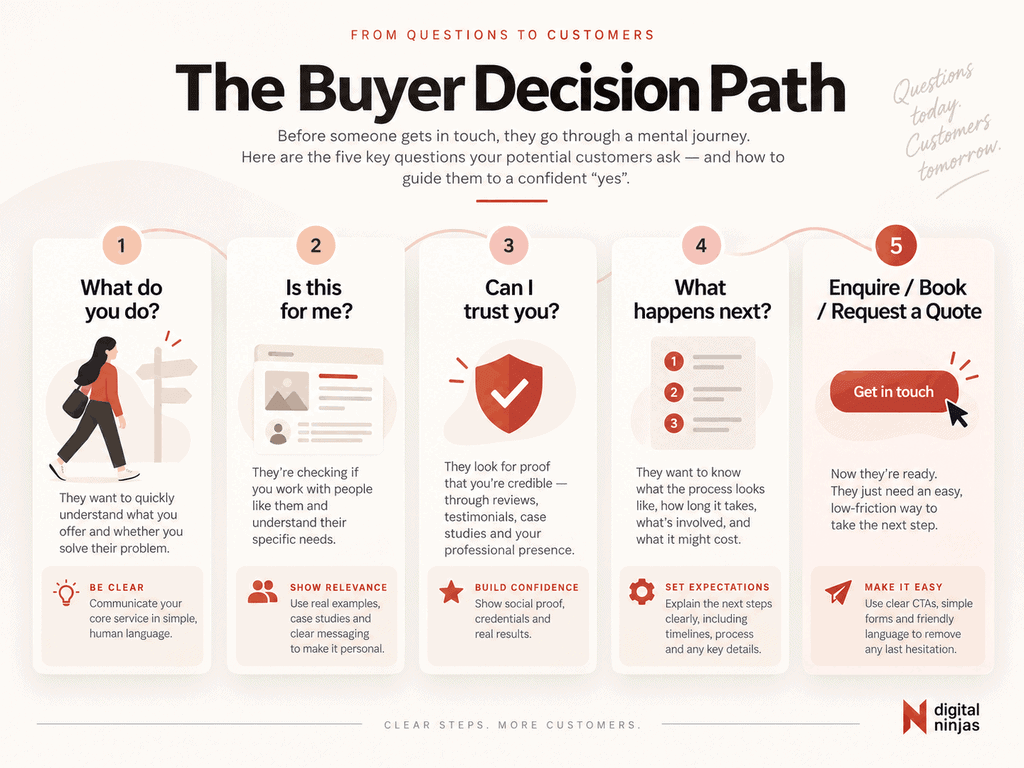
A useful website helps potential customers answer a few basic questions before they ever contact you:
Do you provide what I need?
Do you understand businesses like mine?
Can I trust you?
What will working with you involve?
What should I do next?
This is where website design and content have to work together.
A beautiful site that says very little can still leave people confused. A page packed with information can fail for the opposite reason if visitors cannot find what matters.
The goal is clarity.
That clarity is one of the benefits of a business website that is easy to underestimate. A good site does part of the explanation before a sales conversation ever begins.
Someone should not need to read every page before they understand what your business does and whether it might be relevant to them.
6. It can generate enquiries even when you are not available
Your website does not need to close a sale by itself.
Often, its job is simply to make the next step easy.
That might mean:
- requesting a quote
- booking a consultation
- calling your business
- sending an enquiry
- joining an email list
- downloading a guide
- buying a product
- scheduling an appointment
A customer can do that at 2:00 in the afternoon or 2:00 in the morning.
You still need to follow up properly, of course. A form is not a replacement for good customer service.
But it removes unnecessary friction between interest and action.
The better question is not, “Does my website have a Contact page?”
It is, “Can a potential customer tell exactly what to do next?”
7. It gives you better information about your audience
When people interact with your own website, you can learn much more about what attracts their attention.
With the right analytics and privacy setup, you can see things such as which pages receive traffic, how visitors reached the site, which content gets viewed, and where conversions take place.
That information can influence real business decisions.
Perhaps one service consistently attracts more organic search traffic.
Perhaps a guide keeps bringing in visitors months after publication.
Maybe people reach a pricing page but rarely continue to the enquiry stage.
Those signals do not tell you everything about a person, and analytics should never be treated as mind-reading, but they do give you evidence.
Access to that evidence is one of the reasons to have a business website. Social profiles alone cannot fully replace the insight you can get from your own site.
That is far more useful than making every marketing decision based on instinct.
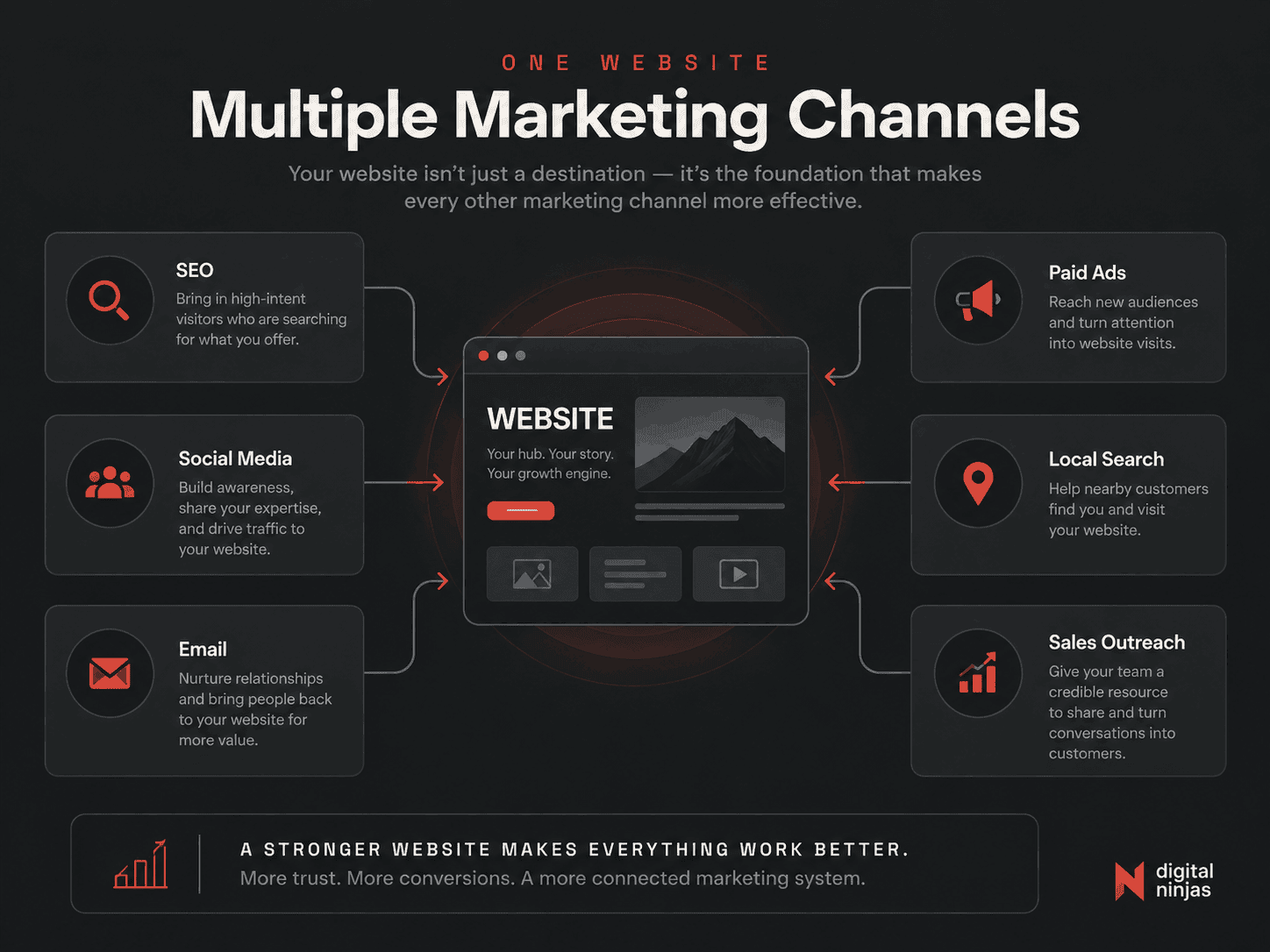
8. It makes your other marketing channels more useful
A website does not need to compete with your social media, email marketing, advertising, or sales outreach.
It can make all of them stronger.
An ad can lead to a page built specifically around the offer being advertised.
A social post can send someone to a detailed guide.
An email can link to a case study.
A sales conversation can be followed by a relevant service page.
SEO has pages to rank.
A Google Business Profile has somewhere useful to send visitors who want more information.
This is one of the broader business website benefits: it can support nearly every other part of your marketing rather than operating as a standalone tactic.
It gives the rest of your digital activity somewhere to land.
9. Your website can grow with the business
Your first website does not need every feature you might eventually use.
A small business may start with five core pages.
Later, the same digital presence might expand to include:
case studies, location pages, resources, online booking, ecommerce, lead magnets, integrations, a careers section, landing pages, or a larger content library.
That is a much more useful way to think about scalability than simply saying you can “customize your website.”
Scalability is another one of the practical reasons to have a business website. A well-planned site can evolve with the company instead of being rebuilt from scratch every time your needs change. What you need today will probably not be identical to what you need three years from now.
The important part is choosing the right foundation for where the business is going, rather than paying for complexity you do not need yet.
10. It reduces your dependence on platforms you do not control
This is closely related to ownership, but the business implication deserves its own section.
If every enquiry comes from one social network, marketplace, directory, or advertising platform, that platform has enormous influence over your pipeline.
A website gives you another route.
People can find you directly. Existing customers can return to you. Referral partners have somewhere permanent to send prospects. Your content can accumulate over time instead of disappearing into a feed.
Your website is not guaranteed to last forever. Domains expire, hosting changes, technology becomes outdated, and websites still need maintenance.
But it is an asset you can migrate, rebuild, improve, and continue developing.
That is very different from building your entire online presence inside somebody else’s account.
Do you need an expensive website to get these benefits?
No.
And expensive does not automatically mean good. The right website depends on what your business needs it to accomplish.
A solo consultant who mainly receives referrals may need a relatively simple site. A growing service business targeting competitive search terms may need considerably more content and SEO work. An ecommerce company has another level of technical requirements altogether.
There are DIY builders, freelancers, studios, agencies, and ongoing website partnerships, all at different price points.
We broke those options down separately in our guide to how much a website costs in 2026.
What matters is simpler: Pay for the website your business actually needs.
Not the cheapest one available, and not the biggest one somebody can sell you.
Does every small business need a website immediately?
Not necessarily.
A brand-new business can sometimes validate an idea through a marketplace, social profile, landing page, or Google Business Profile before investing in a larger website.
There is nothing wrong with starting small.
But as the business becomes more established, the limitations of relying entirely on third-party platforms usually become more noticeable.
You need somewhere to explain the offer properly, and you need pages people can find through search.
You need somewhere for referrals to verify you.
You need more control over what happens between discovery and enquiry.
That is usually when the business website benefits become less theoretical and much more practical.
Business Website FAQs
Does a small business still need a website in 2026?
For many established small businesses, the benefits of a business website include having a central place to explain services, establish credibility, appear in search, support marketing campaigns, and turn interest into enquiries.
A very new business may start with a simpler online presence first. The right time to build depends on how customers discover and evaluate the business.
The benefits of having a website for your business become more noticeable once customers need more information, proof, or clearer next steps than a social profile can provide.
Is social media enough for a small business?
Social media can be enough during the earliest stages of some businesses, particularly when most sales come directly through a platform.
The trade-off is control. Your profile, reach, features, and visibility depend on that platform. A website gives you a digital presence you can structure around your own customer journey and connect with other channels.
What should a small business website include?
At minimum, visitors should be able to understand who you are, what you offer, who you help, and how to contact you.
Depending on the business, that might mean a homepage, individual service or product pages, an About page, testimonials or case studies, FAQs, and a clear contact or booking process.
You do not need pages simply to make the website look bigger. Every page should have a job.
How much does a small business website cost?
There is no single standard price. Cost depends on who builds it, the number of pages, design requirements, content, functionality, SEO, integrations, ecommerce needs, hosting, and ongoing support.
Our full 2026 website cost breakdown compares DIY builders, freelancers, agencies, and monthly website partnerships in more detail.
A website should make doing business with you easier
The strongest benefits of a business website are not really about having another piece of marketing technology.
They are about reducing friction, making the business easier to find, the offer easier to understand, your work easier to verify, and making the next step easier to take for your potential customers.
If your current website does not do those things, adding more pages probably is not the answer. It may simply need clearer thinking behind it.
Editor’s Note: This post was originally published in May 2021 and last updated September 2026.
Every page should have a purpose, and every element should earn its place.
If you are planning a new website or wondering whether your current one is still doing its job, we can help you.